
Introduction
An annual SMSF audit is a legal requirement for every self-managed super fund in Australia. While many funds pass without issue, experienced SMSF auditors often uncover recurring problems that can cause compliance breaches or ATO penalties.
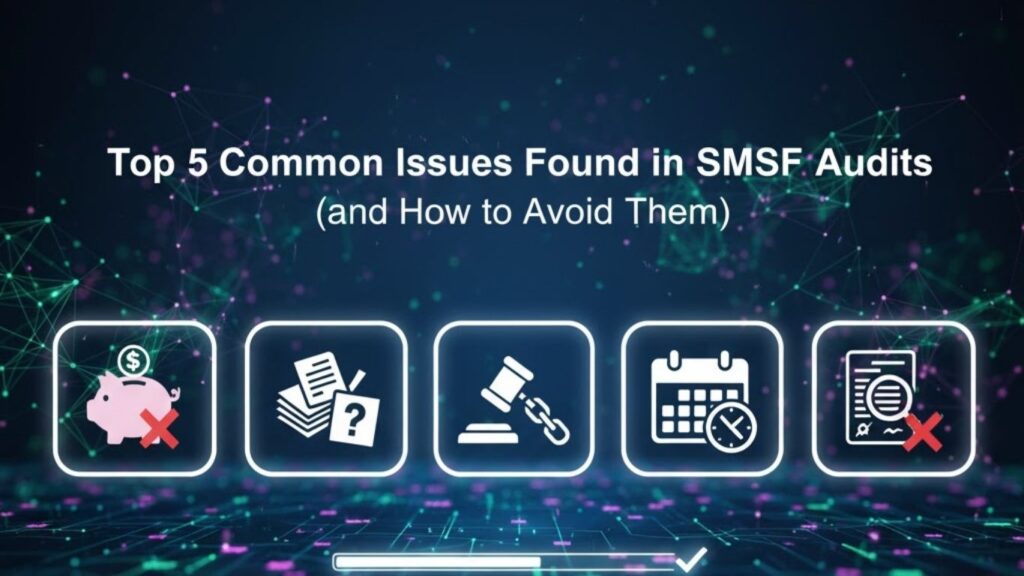
In this article, we’ll look at the five most common issues found during SMSF audits and explain how trustees, accountants, and advisers can avoid them.
1. Valuation Errors
Accurate asset valuations are essential for financial reporting and compliance.
– The issue: Trustees often use outdated or informal valuations for property, shares, or collectibles.
– The impact: Incorrect valuations distort financial statements and can breach SMSF audit requirements.
– The solution: Use professional appraisals, independent data sources, or ATO-approved valuation methods.
At SMSF Audit Link, our independent SMSF audit services review valuations carefully to ensure accuracy.
2. Incorrect Documentation of Contributions
Contributions are one of the most scrutinised areas in an SMSF audit.
– The issue: Contributions may be misclassified as concessional instead of non-concessional.
– The impact: This can lead to members breaching contribution caps and paying unnecessary tax.
– The solution: Maintain detailed contribution records and reconcile them against ATO limits each year.
Our SMSF audit process includes reviewing contribution documentation to prevent errors.
3. Non-Arm’s Length Transactions
All SMSF dealings must be on commercial terms.
– The issue: Related-party leases or transactions that don’t reflect market value.
– The impact: Breaches can trigger compliance penalties under the SIS Act.
– The solution: Document all transactions properly, ensure they are at market value, and avoid informal arrangements.
An independent SMSF audit Sydney or Australia-wide helps detect and correct such issues early.
4. Related Party Loans
Loans involving related parties remain one of the riskiest compliance areas.
– The issue: Trustees sometimes lend SMSF money to members, relatives, or related companies.
– The impact: This can breach the in-house asset limit of 5% and attract serious ATO penalties.
– The solution: Avoid lending SMSF funds to related parties and seek advice before making investments.
Our CPA-qualified SMSF auditors identify related-party loan breaches quickly and report them clearly.
5. Inadequate Investment Strategies
Every SMSF must have a written investment strategy.
– The issue: Trustees fail to prepare or regularly update investment strategies.
– The impact: This is a direct breach of SMSF audit requirements and often flagged during ATO reviews.
– The solution: Document strategies, review them annually, and ensure they align with member needs.
At SMSF Audit Link, our independent SMSF audits verify that strategies meet ATO expectations.
How to Reduce SMSF Audit Issues
The best way to minimise problems is to:
– Keep accurate and complete financial records.
– Meet all SMSF audit requirements before submission.
– Engage a CPA-qualified, ASIC-approved SMSF auditor.
– Use technology like online SMSF audits to streamline communication and document sharing.
Why Choose SMSF Audit Link?
At SMSF Audit Link, we specialise exclusively in SMSF audit services. Our clients benefit from:
– Fixed and transparent SMSF audit fees
– Fast 3–5 day turnaround
– 100% independent SMSF audits — never outsourced or conflicted
– Reviews by senior CPA-qualified, ASIC-approved SMSF auditors
– Secure online SMSF audit solutions for firms across Sydney and Australia
Final Thoughts
Valuation errors, poor documentation, non-arm’s length transactions, related-party loans, and weak investment strategies are among the most common issues identified in SMSF audits. With the right preparation and support from experienced professionals, these problems can be avoided.
By partnering with SMSF Audit Link, accountants and advisers gain confidence that their funds are compliant, efficient, and audit-ready — with fixed SMSF audit fees, a clear SMSF audit process, and trusted independence across Sydney and Australia.